Who Is My Neighbor? The Call to Love Beyond Boundaries
-
by
KLS Admin
“Who is my neighbor?” It sounds like a simple question, but when a religious expert asked Jesus this question, he was looking for a boundary. He wanted to know who qualified to receive his love and compassion.
Jesus answered not with a definition, but with a story—a story that continues to challenge the way we see people today.
The Question Behind the Question
In Luke 10:25–37, an expert in religious law asked Jesus what he needed to do to inherit eternal life. Jesus directed him back to the law, and the man answered that we are to love God with all our heart, soul, strength, and mind, and love our neighbor as ourselves. Jesus affirmed his answer.
But the man wanted to justify himself, so he asked: “And who is my neighbor?”
Perhaps he expected Jesus to give him a category of people he was obligated to love.
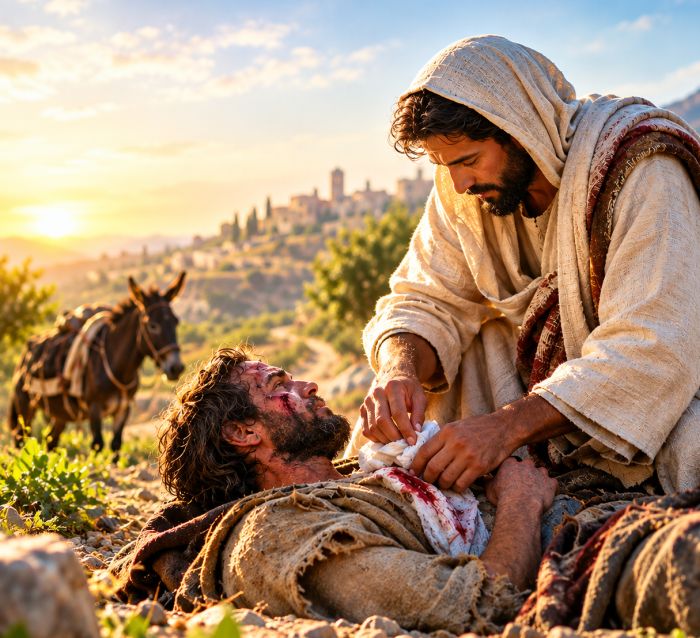
Instead, Jesus told him about a man who was attacked, beaten, robbed, and left half dead on the road from Jerusalem to Jericho.
A priest saw him and passed by.
A temple assistant also saw him and passed by.
Then a Samaritan came along.
And everything changed.
When Compassion Crosses Boundaries
The Samaritan saw the wounded man and had compassion on him. He did not merely feel sorry for him. He went to him, treated his wounds, carried him to an inn, took care of him, and paid for his continued care.
This is what makes the story so powerful.
The man who received mercy was Jewish, while the Samaritan belonged to a group with deep historical hostility toward the Jews. Yet when the Samaritan encountered someone in desperate need, the man’s identity did not become an excuse for indifference.
He saw a human being in need, and he responded with mercy.
That challenges us to examine the walls we have built between ourselves and others—walls of tribe, ethnicity, race, religion, social status, nationality, political differences, past offenses, and personal prejudice.
The lesson from the study is clear: when someone is in need and we are in a position to help, their background should not determine whether we show compassion.
Love Is More Than a Feeling
The Samaritan did not simply feel compassion. His compassion produced action.
He stopped.
He went closer.
He treated the man’s wounds.
He carried him.
He paid for his care.
He even took responsibility for whatever additional expense might arise.
This reminds us that biblical love is not merely an emotion. Love expresses itself through action, sacrifice, and responsibility.
It is easy to love people who love us.
It is easy to help people who belong to our family, community, church, tribe, or social circle.
But Jesus challenges us to go beyond convenient love.
The question is not only, “Who deserves my love?”
The deeper question is:
“Am I willing to become a neighbor to someone who needs me?”
Religion Without Compassion
There is another uncomfortable part of the story.
The priest and the temple assistant were religious people. Yet they passed the wounded man without helping him.
The study points out that the priest may have been concerned about ceremonial uncleanness if the man was dead. His concern about religious requirements became more important than the immediate need of the suffering person.
This presents a serious warning.
We can become so occupied with religious activities, rules, responsibilities, and appearances that we fail to recognize the person God has placed directly in front of us.
Our worship must never make us insensitive to human suffering.
Our knowledge of Scripture should produce greater love, not greater pride.
Our faith should make us more compassionate, not more distant.
Breaking Down the Walls
The Good Samaritan challenges prejudice at its roots.
The Samaritan had every cultural reason to maintain distance, yet he chose mercy.
The lesson from the study is that followers of Christ are called to break down walls of prejudice, hostility, and hatred and build bridges of love and compassion.
This is especially relevant in societies where tribal, ethnic, racial, religious, and social divisions can influence how people treat one another.
Nigeria, like many other societies, has experienced the damaging effects of division and tribalism. The Christian response cannot be to deepen those divisions.
The love of God should be greater than our differences.
If Christ has reconciled us to God, then we are also called to become instruments of reconciliation in the world around us.
The Value of Human Life
One of the strongest applications from the discussion is the reminder that human life is valuable to God.
It is easy to become accustomed to suffering when we see it repeatedly. What once shocked us can eventually become something we simply drive past.
But the Christian cannot become comfortable with human suffering.
The wounded person on the road is not an inconvenience.
The stranger in need is not invisible.
The life of another person carries value because that person bears God’s image.
Therefore, we should cultivate hearts that are sensitive to human suffering and willing to help where we can—while also exercising wisdom and appropriate caution in dangerous situations.
Compassion does not mean recklessness. The discussion itself acknowledges that dangerous situations can involve traps or criminal activity. Spiritual sensitivity includes knowing when and how to act wisely.
Saved by Grace, Called to Walk in Love
There is another important distinction in the teaching.
The message does not present good works as a way of purchasing salvation. The study emphasizes that salvation is received through Christ and that good works follow the life of someone who has received that salvation.
In other words:
We do not love others in order to earn God’s salvation. We love because God’s grace has changed us.
Our good works are not a ticket we purchase into heaven.
They are an expression of the life Christ has produced in us.
That changes our motivation completely.
The unbeliever may do good.
The believer should also do good.
But the Christian’s good works flow from a life that has already been surrendered to Christ.
Who, Then, Is My Neighbor?
Jesus ended the parable by turning the question around.
Instead of answering, “Here are the people who qualify as your neighbors,” Jesus asked which of the three men acted as a neighbor to the wounded man.
The answer was simple:
“The one who showed him mercy.”
Then Jesus said:
“Go and do likewise.”
That is the heart of the message.
Your neighbor is not merely the person who lives next door.
Your neighbor is the person whose path intersects with yours and whose need gives you an opportunity to demonstrate God’s love.
Sometimes your neighbor will look like you.
Sometimes they will not.
Sometimes they will agree with you.
Sometimes they will strongly disagree with you.
Sometimes they will be your friend.
Sometimes they may even be someone you naturally avoid.
But when God gives you an opportunity to show mercy, love should overcome prejudice.
A Final Lesson: Learn to Listen
The same chapter of Luke later tells us about Mary and Martha.
Martha was busy serving Jesus, while Mary sat at His feet listening to His teaching. Jesus gently corrected Martha and said that Mary had chosen what was needed on that occasion.
The study connects this with another important spiritual principle: spiritual sensitivity.
Serving is good.
Listening is good.
Working is good.
But we must learn to discern what God requires in each moment.
There are seasons when we must act.
There are seasons when we must stop and listen.
There are moments when helping requires us to move toward someone in need.
There are also moments when wisdom requires caution.
The mature Christian learns to respond appropriately to the leading of the Spirit rather than simply following a rigid formula.
The Real Question
The lawyer asked Jesus, “Who is my neighbor?”
Perhaps the question we should ask ourselves today is different:
“Whose neighbor am I?”
Who around me needs encouragement?
Who needs forgiveness?
Who needs practical help?
Who have I avoided because of prejudice?
Who have I judged because of their background?
Who is suffering while I am too busy with my own concerns to notice?
The Good Samaritan reminds us that love is not defined by proximity, similarity, or convenience.
Love crosses boundaries.
Love sees.
Love stops.
Love serves.
Love sacrifices.
And ultimately, love shows mercy.
Jesus did not simply tell us to identify our neighbors.
He told us to become neighbors.
Go and do likewise.
Latest posts
- Rediscovering the Power and Purpose of Prayer
- Handling Conflict: How Couples Can Have Difficult Conversations God’s Way
- Who Is My Neighbor? The Call to Love Beyond Boundaries
- What Jesus Did: Raising People Who Look Like Christ
- Scars That Remain After Forgiveness
- Dealing With the Inside Job: Confronting What Is Hidden Within
- Representing God’s Kingdom in Everyday Life
- Resolving Marital Conflicts God’s Way
- Dealing With the Pressures of Life: Trusting God When You Don’t Understand
- Living With a Sense of Destiny
- Appearance Christianity: When Faith Becomes a Performance
- The Beatitudes on the Plain: A Call to True Transformation
- The Mind of Christ: Embracing Humility, Love, and the Kingdom of God
- Navigating Widowhood
- How to Pursue Your Divine Purpose with Endurance and Eternal Focus
- The Life-Transforming Miracle: How Divine Encounters Change Destiny Forever
- Why Godly People Still Suffer
- Stewardship, Integrity, and Faithfulness in God’s Kingdom
- The Power at Work in Us